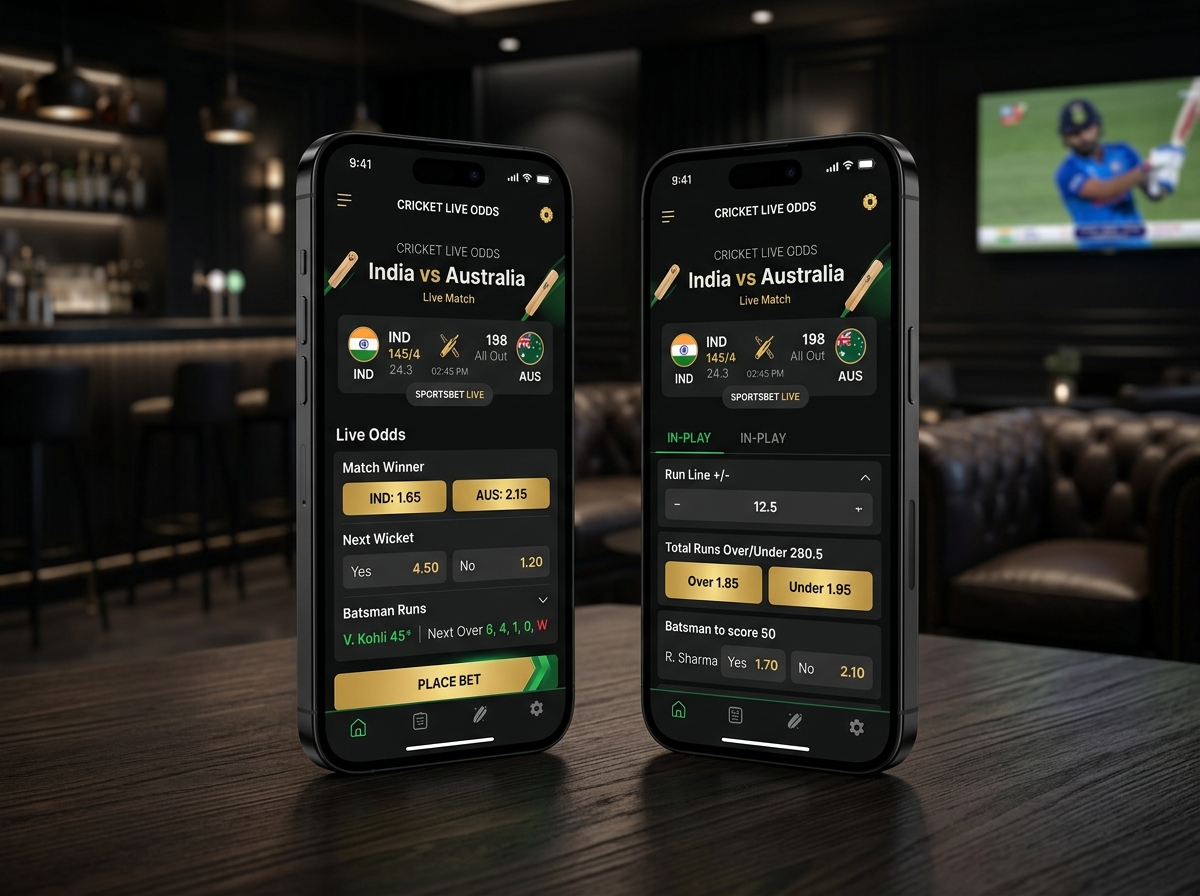
Understanding the 3 Critical Phases of an IPL T20 Innings
Modern Twenty20 cricket moves at an electrifying pace where momentum can swing within a single over. However, treating a live cricket match as a continuous, uniform contest is one of the most common mistakes spectators make. To accurately assess match dynamics on a scorecard or platform screen, an innings must be evaluated across its three distinct operational phases: the Powerplay, the Middle Consolidation, and the Death Overs.
1. The Powerplay (Overs 1 to 6)
During the mandatory opening six overs, fielding teams are restricted to placing only two fielders outside the 30-yard circle. Batting units deliberately adopt aggressive field-piercing strategies to maximize run yield against the hard new ball. When observing the Powerplay, do not evaluate total runs in isolation; evaluate the wicket-to-run ratio. A score of 58/0 represents tactical dominance, whereas 58/3 signals severe top-order vulnerability that alters the entire remainder of the innings.
2. Middle Overs Consolidation (Overs 7 to 15)
Once five fielders disperse to the boundary, boundary percentages typically decrease and strike-rotation becomes paramount. Spinners and pace-off seamers operate through this phase. Teams that successfully score at 7.5 to 8.5 runs per over through singles and twos while retaining wickets enter the death overs with immense leverage.
3. Death Overs Climax (Overs 16 to 20)
The death phase is characterized by maximum boundary intent and defensive yorker/slower-ball execution. Wickets lose marginal value during this phase as batters prioritize boundary strike rates. Historical IPL statistics show that teams with recognized finishers and wickets in hand routinely score 55 to 70 runs in the final five overs.
Stadium Dimensions, Pitch Profiles and the Dew Factor in India
Indian cricket venues exhibit dramatically varied playing conditions that dictate match tempo. Applying uniform expectations across different grounds leads to flawed interpretations. Consider the historical playing characteristics of marquee Indian venues:
| Venue | Pitch Nature | Avg 1st Innings | Dew Impact | Tactical Focus |
|---|---|---|---|---|
| Wankhede Stadium, Mumbai | Red soil, true bounce, short boundaries | 178 runs | Severe (Heavy) | Chasing advantage, high boundary percentage |
| M. Chinnaswamy, Bengaluru | High altitude, lightning outfield, small boundaries | 184 runs | Moderate | Six-hitting venue; defendable totals exceed 205+ |
| M.A. Chidambaram (Chepauk), Chennai | Clay-based, grip for spin, lower bounce | 162 runs | Minimal to Low | Spin choke, strike rotation, target 170+ |
| Eden Gardens, Kolkata | Balanced, good carry, responsive to seam | 175 runs | High in Spring | Powerplay aggression, high run chases |
| Narendra Modi Stadium, Ahmedabad | Red and black soil variations, spacious boundary | 170 runs | Moderate | Running between wickets, large square boundaries |
The Impact of Night Dew
During evening IPL fixtures starting at 7:30 PM IST, moisture settles on the grass surface during the second innings. This dew renders the cricket ball slick, impeding spinners from gripping the seam and hampering seamers from executing yorkers. Consequently, the team batting second often enjoys a notable mechanical advantage, explaining why captains overwhelmingly elect to field first upon winning the coin toss.
Demystifying the Duckworth-Lewis-Stern (DLS) Method
Inclement weather frequently interrupts limited-overs cricket. When rain curtails an innings, simple mathematical run-rate extrapolation is invalid because it ignores the crucial resource of remaining wickets. The International Cricket Council (ICC) employs the Duckworth-Lewis-Stern (DLS) mathematical model to establish revised targets.
The DLS method measures two core assets: overs remaining and wickets in hand. If Team A scores 180 in 20 overs and rain interrupts Team B after 10 overs at 85/1, Team B's required target will be fundamentally different than if they were 85/5. Always verify the officially displayed DLS par score on official match scorecards rather than relying on broadcast commentators' informal estimates.
Distinguishing Observation from Certainty
A disciplined observer maintains a strict boundary between verified match data and speculative forecasting. Cricket is inherently subject to high variance: a brilliant direct-hit run-out, an unplayable delivery, or an unexpected DRS overturn can alter the equilibrium instantly.
- Data Observation: The bowling side has conceded only 18 runs across the last 3 overs.
- Analytical Deduction: Pressure is mounting on the current batting pair to accelerate.
- Inherent Uncertainty: The next over could yield a wicket or three consecutive boundaries; neither outcome is guaranteed.
Frequently Asked Questions (FAQ)
What is the average winning total in an IPL T20 match?
Across all IPL grounds, the average winning first-innings score is approximately 175 to 185 runs. However, venue characteristics create large variances: at the M. Chinnaswamy Stadium, par scores routinely exceed 200, whereas at Chepauk in Chennai, totals around 165 are highly defendable.
Why does the toss have such a significant influence on night matches?
The toss determines who bowls under second-innings dew. Wet outfields make it difficult for bowlers to maintain ball grip, reducing swing and spin while enabling the ball to skid smoothly onto the bat, significantly aiding the chasing team.
How does the DLS method calculate revised targets in shortened games?
The Duckworth-Lewis-Stern formula calculates each team's available resources as a percentage based on both balls remaining and wickets lost. It recalculates fair targets proportionally rather than relying on crude run-rate multiplications.
What is the difference between bowling economy and strike rate?
Economy rate represents the average number of runs conceded per over bowled (Runs / Overs). Bowling strike rate represents the average number of deliveries required to claim a wicket (Balls / Wickets). Both metrics provide complementary insight into a bowler's match impact.